Polymarket put a price curve for renting Nvidia GPUs on its new dashboard on November 25, when the spot benchmark for an H100 was $3.25 per GPU-hour. The market implied $2.16 an hour for December 2028, 33.5 percent below that afternoon’s spot reading.
“Think of it as a yield curve for the cost of compute,” Polymarket founder Shayne Coplan wrote on X. His chart used an earlier $3.05 spot reading, putting the same $2.16 estimate about 29 percent lower. Both comparisons describe H100 rentals.
The H100 rental price curve
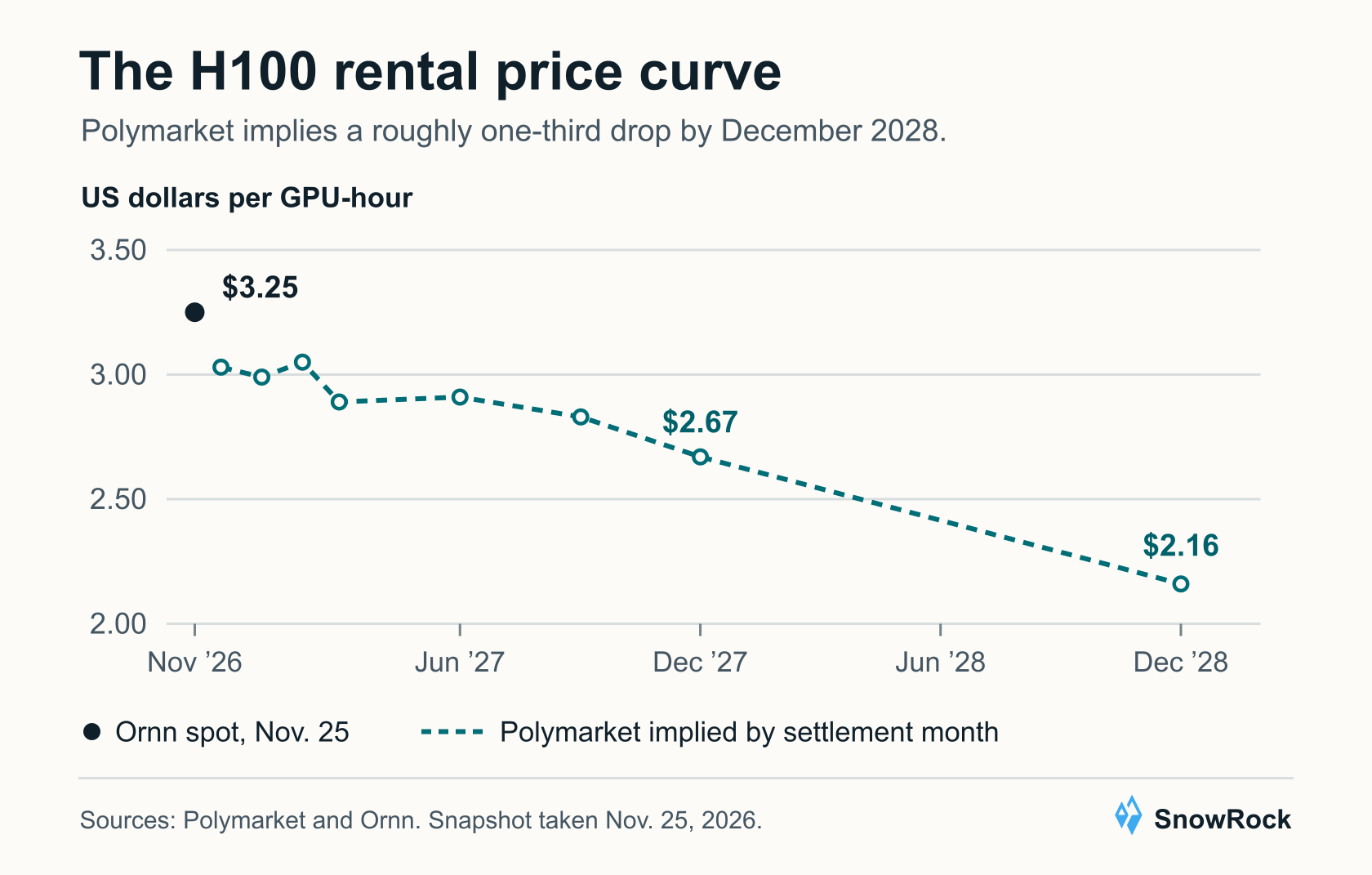
Ornn’s spot H100 rental benchmark was $3.25 per GPU-hour on November 25, 2026. That afternoon Polymarket implied $2.16 for December 2028, about 34 percent lower. Chart by SnowRock using data from Polymarket and Ornn.
Polymarket and Ornn
At about 2:58 p.m. Eastern, the dashboard showed $3.03 for December 2026, $2.99 for January 2027, $3.05 for February and $2.89 for March. June edged up to $2.91 before September’s $2.83 and December’s $2.67. On X, Prakarsh, who posts as Baremetal Balak, expected H100 rents to fall. The account litquidity asked what would drive the short end of the curve.
Spot rates had moved in different directions that week. H100s were up 10.9 percent, B200s rose 6.4 percent to $9.80 and B300s fell 7.1 percent to $10.83. Rental rates can offer an indirect clue to Nvidia’s pricing power because they reflect what customers pay to use its chips. For an AI company serving requests, the cost per answer also depends on how many tokens a chip processes and how much of its capacity goes unused.

After each listed calendar month ends, contracts settle based on whether the mean of that month’s finalized daily Ornn Compute Price Index readings, rounded to the nearest cent, strictly exceeds the specified threshold, with no GPU hours changing hands. Ornn builds its index from completed on-demand rentals, excludes offered prices, weights trades by volume and caps the influence of extreme prices. It keeps contributor names private.
Splitrule asked on X how closely the benchmark would track the bill for a buyer on a 12-month capacity deal. That gap is the basis risk of the hedge. Spreads and order-book depth determine what a buyer can trade at a given price. Across 24 events, Polymarket reported $4.02 million in cumulative volume and $923,828 in open interest on November 25.

The dashboard brought existing trading into view. Ornn also publishes a separate curve built from reserved-capacity rates. When ICE and Ornn announced plans for GPU futures in May, Hyperbolic Labs co-founder Jasper Zhang said “we’ve seen firsthand how volatile and fragmented the compute market has become.” After Polymarket announced a six-figure block trade in June, FalconX’s Ravi Doshi said, “This transaction highlights the accelerating demand for financial infrastructure in the compute space.”
Predictions
Near-dated H100 contracts are likely to see more trading. December 2026 contracts had $386,217 in cumulative volume versus $58,160 for December 2028. Several weeks of higher far-dated trading volume would weaken that prediction. If H100 spot rents fall while newer chips hold their premiums, that would strengthen the case that the drop is specific to older hardware. One week of mixed prices leaves that question open.
Common questions
What did Polymarket launch on November 25, 2026?
It launched a public dashboard that plots market-implied hourly rental prices for Nvidia H100, B200 and B300 GPUs alongside Ornn’s latest spot readings. The underlying markets had already traded.
How much did an Nvidia H100 cost to rent on November 25, 2026?
Ornn’s H100 spot benchmark was $3.25 per GPU-hour, up 10.9 percent from the previous week. A GPU-hour means renting one graphics processor for one hour.
What does the Polymarket curve imply for H100 rentals in December 2028?
It implied $2.16 per GPU-hour for December 2028, 33.5 percent below the $3.25 spot reading on November 25, 2026.
Why did Coplan’s chart show a drop of about 29 percent?
Coplan’s November 25 chart compared the same $2.16 figure with an earlier H100 spot reading of $3.05 per GPU-hour. The percentage changes when the starting price changes.
How much were Nvidia B200 and B300 GPUs renting for?
On November 25, the B200 spot benchmark was $9.80 per GPU-hour, up 6.4 percent over the week. The B300 benchmark was $10.83, down 7.1 percent.
What does an implied GPU rental price represent?
It is a dollar-per-hour estimate Polymarket derives from contracts on whether a monthly rental benchmark will exceed different price thresholds. Each threshold contract has its own odds.
How does Ornn calculate its GPU price index?
Ornn uses completed on-demand rentals, weights them by the number of GPUs traded and caps the influence of extreme prices. It excludes offered prices, publishes a separate benchmark for each chip and keeps provider identities private.
What happens if the monthly H100 index average equals the contract’s threshold?
The contract resolves No. A Yes payout requires the monthly average of finalized daily readings, rounded to the nearest cent, to be strictly above the threshold.
Can a cloud customer hedge a GPU bill with these markets?
A position can offset some increases if the customer’s bill moves with the Ornn index. A negotiated 12-month capacity deal may respond differently from a benchmark of on-demand rentals.
How much trading had these GPU markets attracted?
Polymarket reported $4,022,786 in cumulative volume and $923,828 in open interest across 24 events on November 25. December 2026 H100 contracts had $386,217 in volume and $101,200 in open interest, compared with $58,160 and $14,290 for December 2028.
Does a one-third drop in H100 hourly rates imply a one-third drop in AI inference costs?
Only if the workload uses the same amount of H100 time per request and GPU rental is its entire cost. Chip throughput, utilization and other operating costs affect what it costs to serve a request.
When did institutional GPU hedging appear on Polymarket?
Polymarket announced a six-figure H100-linked block trade between FalconX and AneraLabs on June 2, 2026. On May 19, ICE and Ornn had announced plans for cash-settled GPU futures, subject to regulatory approval.