Key takeaways
- METR measured a roughly 3.6-month doubling time for the length of tasks models could complete at 50 percent reliability on its November 2026 test suites.
- Epoch AI found that training compute grew four to five times a year through May 2024. Its separate capability index rose 14 points a year for frontier reasoning models after September 2024.
- The strongest sign of a fast takeoff would be independently verified discoveries from successive generations of AI built with substantial help from their predecessors.
An AI fast takeoff would begin when machines help build better machines, and each generation makes the work of building the next one faster. That feedback loop could push AI from useful research assistant to a system that outperforms human experts across much of their work in a short period. There is evidence that the first part has begun. How quickly it can compound is the open question.
On Nov. 24, the pseudonymous futurist Dr Singularity asked what would happen if a few million scientists, whom the account put at an average IQ of 120 to 130, gave way to billions of AI researchers with IQs above 200, working around the clock. “We're going to find out,” the author wrote, putting the timeline at three to five years and suggesting that breakthroughs imagined for the 2300s might arrive in the 2030s. Those figures are the author's assumptions and forecasts.
For that to happen, AI would have to do more than complete assigned work. It would have to choose good questions, run experiments whose outcomes are uncertain, recognize when it is wrong and deliver findings that somebody else can reproduce. Its operators would also need enough chips and electricity to run it at scale, and enough people, equipment and institutions to turn the discoveries into something the world can use.
What a billion researchers would buy
UNESCO counted about 8.9 million full-time-equivalent researchers worldwide in 2018. The U.S. National Science Board counted 3.5 million science and engineering articles published worldwide in 2024. The two figures describe different years and populations. They give a sense of the system an AI workforce would be joining, including the people who design trials, maintain instruments and check results before a paper appears.
Take one billion agents, a conservative round number for the scale the post imagines. If each could do useful research at a human rate for 168 hours a week, against an illustrative 40-hour human workweek, the total would be about 475 times the labor hours of UNESCO's 2018 workforce. That calculation assumes every copy gets enough compute, works independently on something worth doing and turns an hour into useful output at the same rate. Double the useful work per hour and the theoretical total doubles. Give ten copies the same blind spot and they may produce ten versions of the same mistake.
The IQ figures supply no sound multiplier. In a 2019 paper, AI researcher François Chollet proposed measuring “skill-acquisition efficiency,” or how well a system learns a genuinely new task given what it already knows and how much experience it gets. A model can answer more test questions simply because it has seen more examples. An AI researcher has to work out which questions are worth answering before anyone has written the test.
Three measures of faster progress
In its Nov. 20 update, the independent evaluator METR estimated that its combined task horizon had roughly doubled every 3.6 months. The horizon is the time a human would take to do a task that an AI can complete with a specified chance of success. METR's headline fit uses 50 percent. On a task that takes a person a day, that means a model succeeds about half the time under the test conditions. It says nothing about whether the model spent a day working.
How AI task horizons have grown
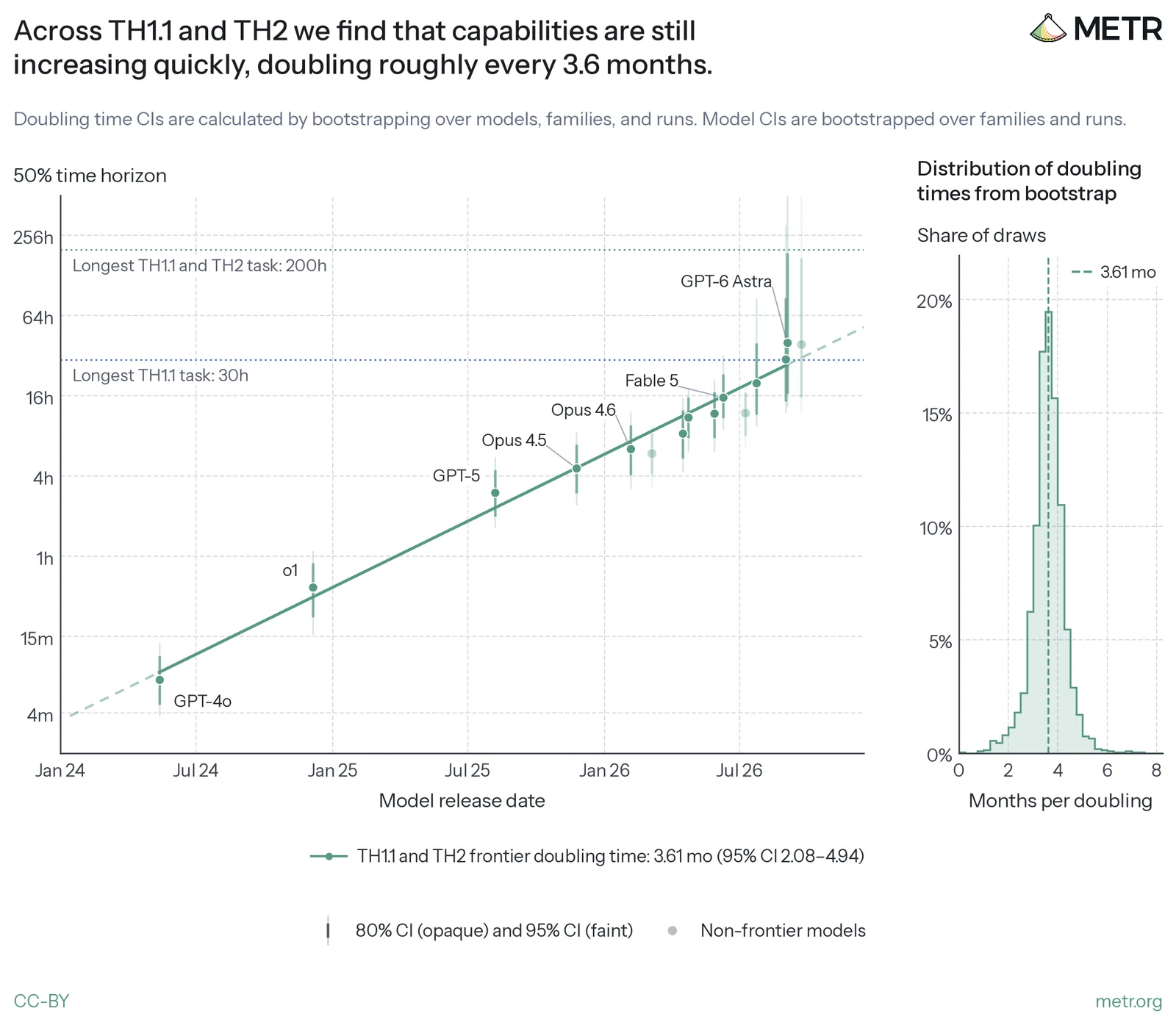
METR's own November 2026 chart tracks AI task horizons on its TH1.1 and TH2 task sets. Its fitted doubling time is 3.61 months, with a 95% confidence interval from 2.08 to 4.94 months. Source: METR, CC BY.
METR
Epoch AI found that the computing work used to train notable and frontier models grew roughly four to five times per year in its analysis through May 2024. That is spending of computational effort on training, distinct from the cost of running a billion assistants. In its September 2026 capability analysis, Epoch scored the March 2023 GPT-4 at 126.2 and the June 2026 Claude Fable 5 at 162.5. The best reasoning models gained roughly 14 points a year after September 2024, compared with six points a year on the non-reasoning frontier. The index combines benchmark results. Neither a point nor a doubling means twice as many discoveries.
The growth in frontier training compute
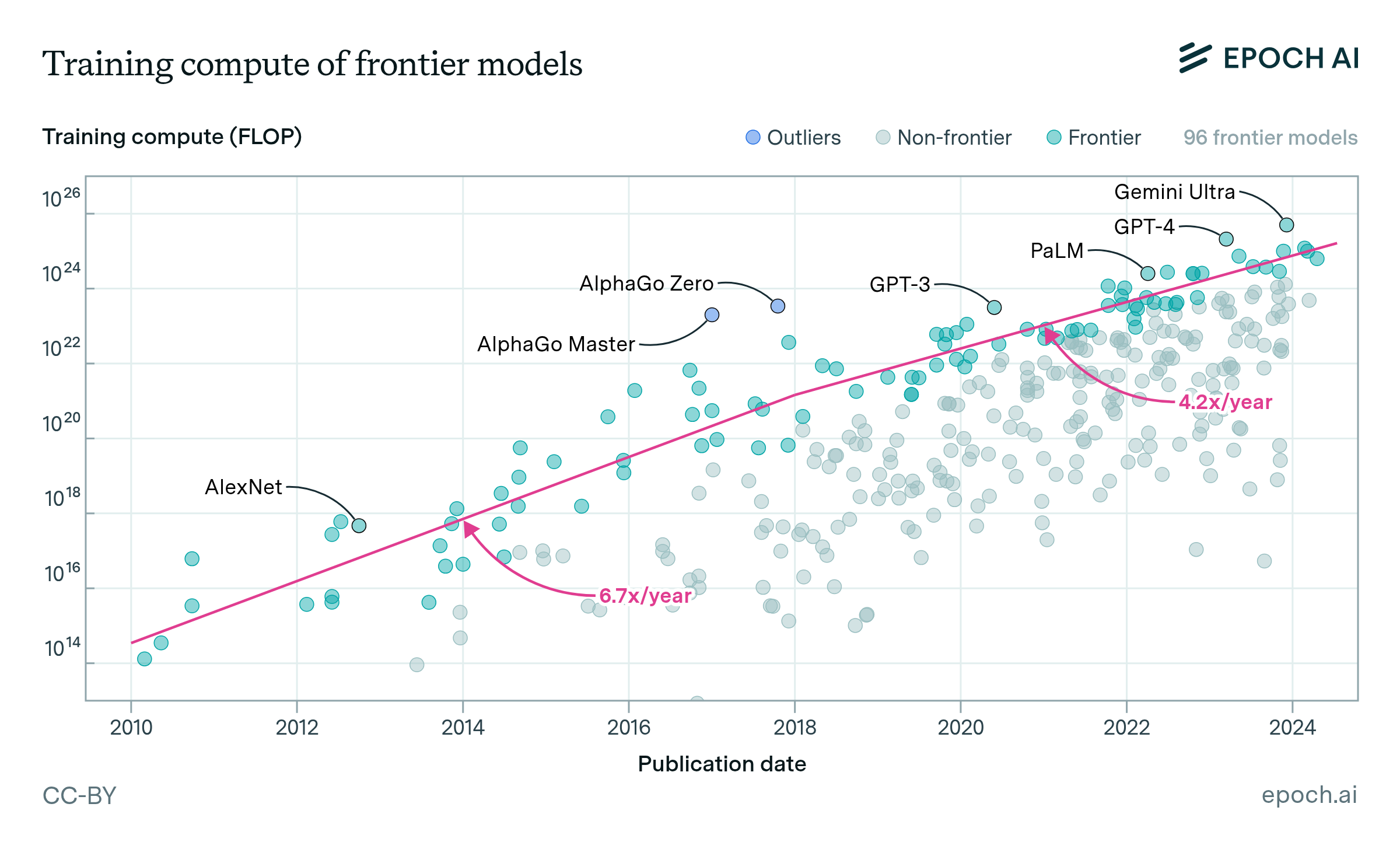
Epoch AI's own chart plots the training compute of frontier models through 2024. Its later fitted trend is 4.2 times per year. Source: Epoch AI, CC BY.
Epoch AI
Where frontier reasoning models pulled ahead
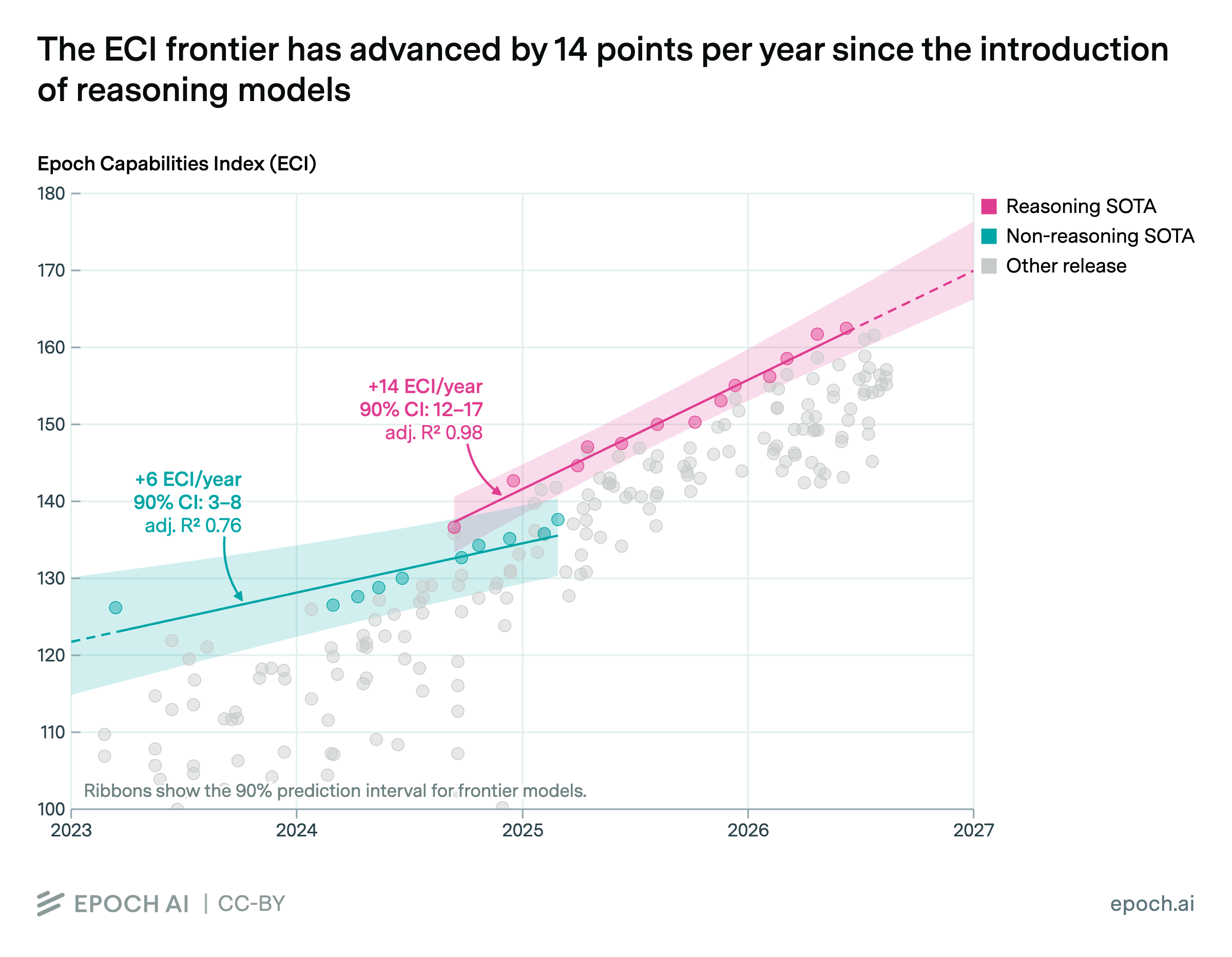
Epoch AI's own chart compares its capabilities index for frontier reasoning and non-reasoning models. The reasoning frontier rose by an estimated 14 points per year following the introduction of reasoning models in 2024. Source: Epoch AI, CC BY.
Epoch AI
Three ways to measure AI progress
| Measure | Observed trend | What it measures |
|---|---|---|
| METR task horizon | Doubled about every 3.6 months in the November 2026 combined-suite fit | Human time for tasks an AI succeeds at half the time |
| Epoch AI training compute | Grew about four to five times per year through May 2024 | Computation used to train models |
| Epoch Capabilities Index | Frontier reasoning trend of about 14 points a year after September 2024 | Relative performance across a collection of benchmarks |
The three trends use different units, model samples and dates.
METR and Epoch AI
In October, METR proposed measuring research acceleration inside the companies building the models. Its concern was that gains in developing AI could outpace progress in controlling it.
A close look inside Anthropic showed how hard that is to measure. In a Nov. 5 assessment, METR estimated that the company's models had improved on an internal benchmark index about 1.9 times as fast after October 2025 as before. The evaluators thought AI assistance explained much of the acceleration and said fully autonomous work still made few substantial contributions to the most important parts of training. Anthropic redacted much of the evidence behind the findings.
OpenAI's Nov. 18 report describes where researchers use coding agents to implement ideas and debug experiments, and where staff still have to choose ideas and rescue unsuccessful work. The question for the next model is whether it can lift that burden from the researchers building it.
The people betting on a takeoff
In June 2025, OpenAI chief executive Sam Altman wrote that “the takeoff has started.” He described today's AI-assisted research as an early form of recursive self-improvement and envisaged a larger change if a lab could fit a decade of research into a year or a month. In September 2026, after Amodei urged developers to pace frontier AI, Altman endorsed giving independent evaluators access comparable to employees'.
Anthropic chief executive Dario Amodei described a “country of geniuses in a datacenter” in his January 2026 essay. His scenario puts millions of copies to work and imagines some cognitive steps happening many times faster than humans can perform them. He also identified a limit within his own scenario: software and physical equipment may take the same time to respond no matter how quickly an agent thinks.

Demis Hassabis, the co-founder of Google DeepMind, wrote in July that artificial general intelligence “is probably only a few short years away.” His milestone was broad human cognitive ability. In September he backed the direction of Amodei's proposal and pointed to a frontier AI standards body.

Elon Musk set a higher bar in February when he told the Dwarkesh Podcast, “I think maybe in five or six years, AI will exceed the sum of all human intelligence.” The forecasts give a sense of how soon the executives expect powerful systems. They leave an empirical question for researchers: what would count as a verified discovery attributable to one AI building another?

Where the skeptics would look
Chollet argued in a 2017 essay that “intelligence is necessarily part of a broader system.” A scientist's reasoning depends on access to observations, tools and other people who can spot mistakes. Yann LeCun, a Turing Award winner, said in a 2026 interview that current systems fall short “in their understanding of the physical world and ability to plan.” He expects machines eventually to match people in science. His objection is that present systems lack some abilities needed to get there.
Epoch AI tried a version of that test in October, giving agents an open-ended assignment to come up with an advance in AI training comparable to one human researchers had already published.
Agents ran experiments and managed some progress, but the evaluator found little that met the standard of the original research. A good test of that objection would be to hand an agent an experiment with ambiguous results. Can it recognize that the instrument drifted or that the experiment cannot distinguish two competing explanations? A million copies will help if they find and check different answers. If they share the same misconception about the instrument, their agreement tells you little.
If the forecast is even half right
Some of the biggest gains could arrive in stages. In 2022, Google DeepMind and EMBL-EBI released more than 200 million predicted protein structures through the AlphaFold database. That illustrates how fast an advance can spread when its output is digital. A team that identifies promising drug candidates more quickly still has to test them, recruit patients and collect evidence of safety and benefit. By the 2030s, a plausible first payoff would be more promising medicines making it into trials, with acceleration varying by disease and treatment.
Software firms could redesign a product faster than manufacturers could retool a plant. Better battery designs could be tested more often, while factories, supply contracts and grid connections take longer. For governments, faster research might improve forecasting, analysis and logistics well before it changes how quickly a military can procure equipment. The economic and political benefit would depend in part on who can afford to run the best systems and who can inspect their work.
What to watch in 2027
SnowRock expects AI-assisted research to get faster in 2027, especially where experiments are cheap and results can be checked automatically. The case for a fast takeoff would strengthen if independent evaluators saw a model choose and verify an important improvement that made its successor demonstrably better at doing the same work. Repetition across labs and model generations would carry much more weight than one striking result.
Watch whether models succeed consistently on open-ended research tasks, whether labs can document genuine discoveries that originated with their agents, and whether the cost of each verified result falls. If models win on longer benchmarks but still need people to choose the research direction and identify faulty results, the likely outcome is a faster laboratory with humans still running it. The distinction will become visible first in the work labs can show, one experiment at a time.
Common questions
What is a fast takeoff in AI?
In the 2026 debate, an AI fast takeoff means rapid, compounding improvement as AI makes it easier to build more capable AI. It requires a feedback loop across generations of systems.
What did Dr Singularity predict about AI researchers?
On Nov. 24, 2026, the account predicted that billions of superintelligent AI researchers could work around the clock within three to five years. The numbers are the author's forecast.
Does AI have an IQ above 200?
No established measure puts AI at a human-equivalent IQ of 200. In 2019, François Chollet proposed measuring how efficiently a system learns unfamiliar tasks.
How many human researchers are there?
UNESCO counted about 8.9 million full-time-equivalent researchers worldwide in 2018. That sums time spent on research across workers.
How fast is the AI task horizon increasing?
METR's Nov. 20, 2026 analysis found a doubling time of about 3.6 months across its combined task suites. Its headline estimate uses a 50 percent chance of success.
Does a 50 percent task horizon measure how long AI works?
No. In METR's November 2026 study, the time is how long the task would take a human. The 50 percent is the model's estimated success rate on a task of that length.
How fast was frontier AI training compute growing?
Epoch AI estimated growth of roughly four to five times per year in its analysis through May 2024. It was measuring the computation spent on training.
How fast are AI capabilities rising on Epoch's index?
In its September 2026 analysis, Epoch AI estimated that the best reasoning models advanced roughly 14 points a year after September 2024. Its fitted non-reasoning trend was about six points a year.
Is AI already improving itself?
AI is assisting the labs that make its successors. METR's November 2026 assessment of Anthropic found signs of faster research, with fully autonomous work still making few major contributions to the most important parts of training.
What did Dario Amodei mean by a country of geniuses in a data center?
Amodei's January 2026 essay described millions of copies of highly capable AI that could divide up work and act rapidly. It was a scenario for thinking through the consequences.
Could an AI fast takeoff bring medicines to patients in the 2030s?
Faster discovery could move some candidates into trials sooner in the 2030s. Testing in people and regulatory review would still determine which medicines patients get.
What would count as evidence of a fast takeoff in 2027?
Look for at least two successive, independently verified cases where AI originated important improvements that made its successor substantially better at developing the next model. Falling cost per verified discovery would strengthen the evidence.