12 min read · 4:35 PM ET
Record ETF inflows, data center construction wages turning up in county pay statistics, and a widening gap between what a rideshare costs and what the driver keeps.
Key takeaways
- ETF inflows are running roughly 600 billion dollars ahead of last year, with thematic products taking a growing share of the total.
- The clearest measured labor market effect of the AI build out so far is higher pay for skilled trades, not displaced office work.
- Ridesharing shows what happens after an intermediary wins the demand: fees widen quietly while both sides of the market celebrate record numbers.
Exchange traded funds have quietly become the main way most people own the market. Cheap, easy to buy, easy to sell, easy to market. Whatever the theme of the moment happens to be, somebody has already wrapped a ticker around it. Right now the theme of the moment is being poured out of a concrete truck in a township you have never heard of.
Money is pacing for its strongest year into funds, ever.
Per data from Citadel, ETF net inflows are running for their best year on record, roughly 600 billion dollars ahead of last year's pace. July alone set an all time monthly high.
ETF flows are setting a record pace.
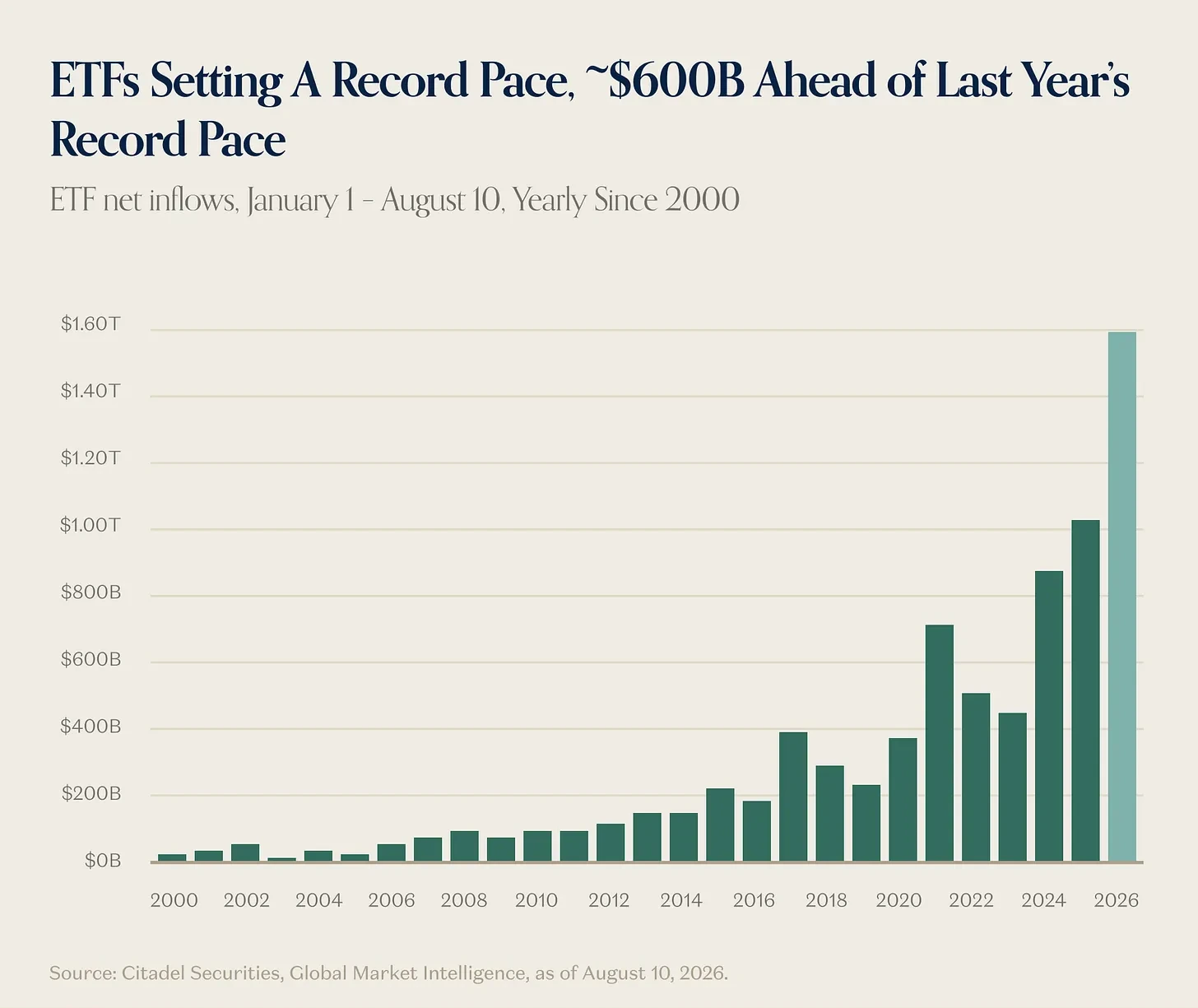
Cumulative net inflows against the prior year. The gap opened early in the year and never closed.
Citadel.
July was a new all time high.
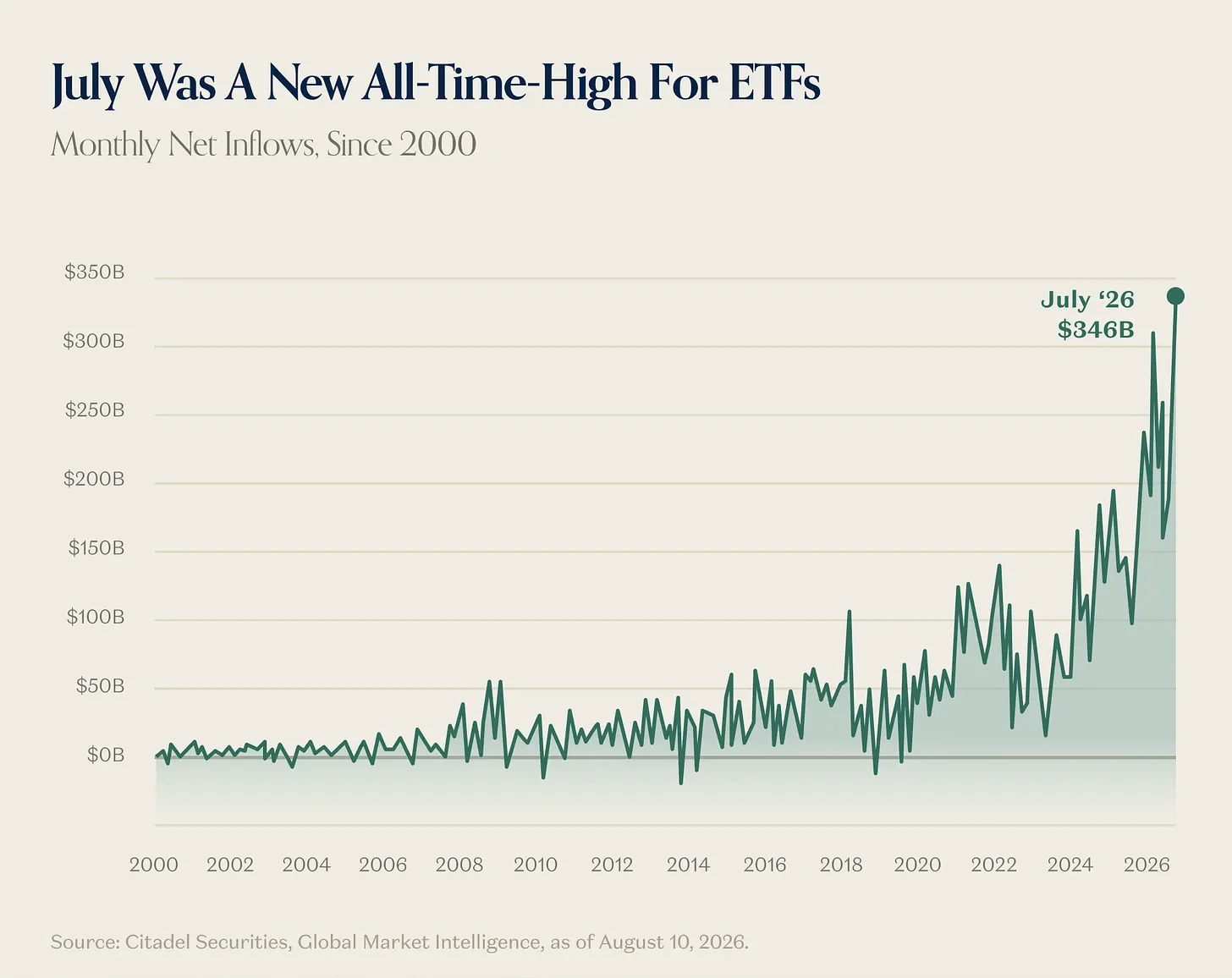
Monthly net inflows by year. Single months are setting records in a market that is supposed to have gotten cautious.
Citadel.
Low fees, low barriers, easy distribution, good marketing, more retail participation. All of that explains the total. None of it explains the interesting part, which is what the money is buying.
In 2020 the top themes were clean energy, emerging markets tech, and healthcare. In 2026 the leaderboard reads AI, nuclear, space, defense, infrastructure. That is a complete rotation in six years, and every item on the new list requires steel, land, permits and a substation. Atoms took the leaderboard back from bits.
Passive money moving on purpose is still an opinion. It just arrives with better fees.
Whether the trade works out is not the question here. The relevant fact for an operator is that capital of this size does not turn around quickly, and it has already decided the physical layer of AI is where the return sits. Whatever the next three years look like, they are funded.
Data center construction jobs are a blue collar bonanza.
People love data centers in their ETFs and increasingly do not love them anywhere within sight of the house. Set that debate aside. Like them or not, in a growing number of places the data center is the biggest economic event in town.
Data centers are driving large shares of construction spending.
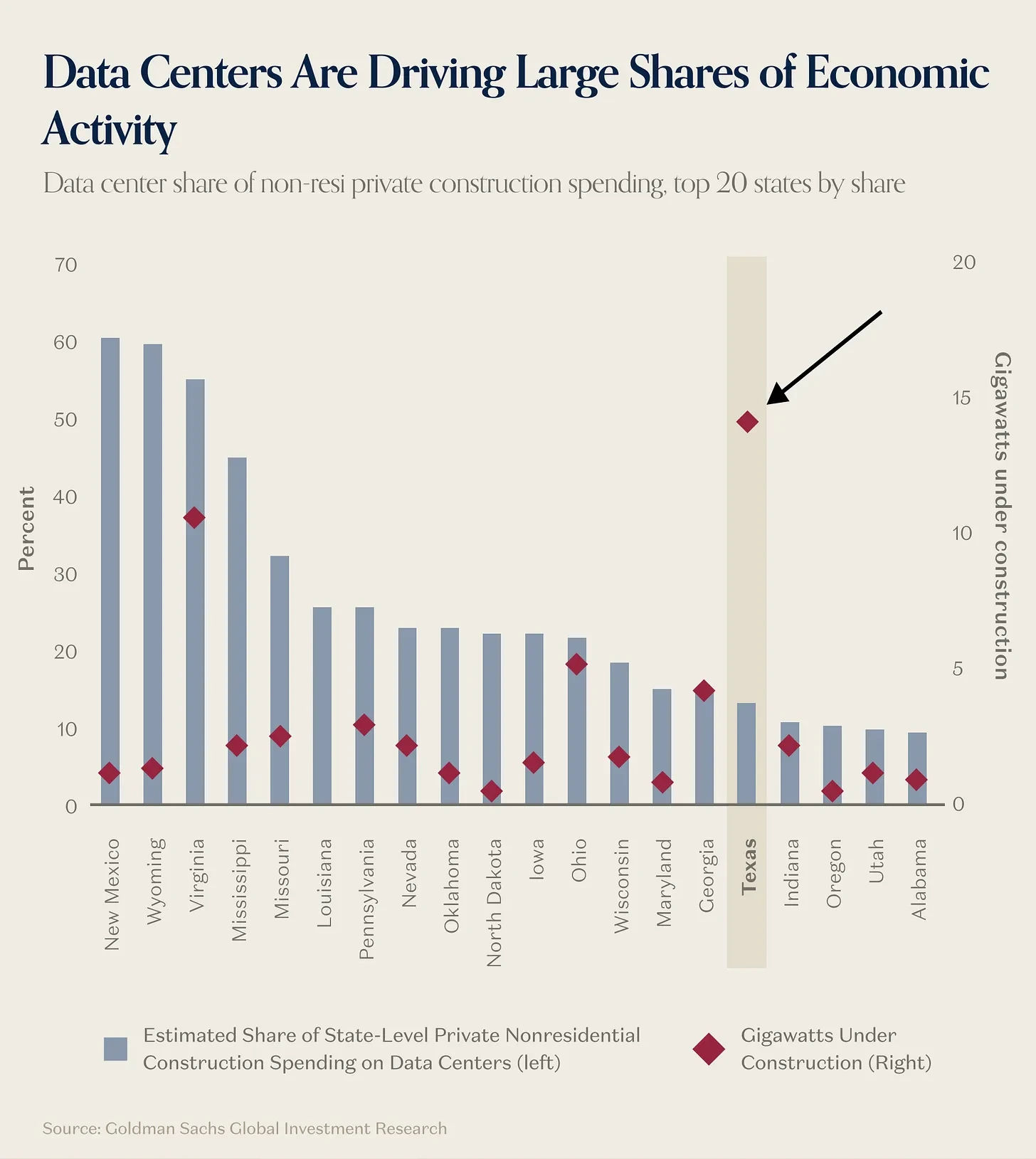
New Mexico and Wyoming are not building much capacity, under three gigawatts, but they do not build much of anything, so data centers land at roughly 60 percent of all private non residential construction. Pennsylvania, with about three gigawatts, is near 30 percent. Texas is building far more and it still comes to about 10 percent of a very large number.
State construction spending data.
Wells Fargo tried to tabulate the economic benefits running alongside these projects, splitting counties with operating facilities from counties currently building them.
Counties with data centers are doing pretty well.
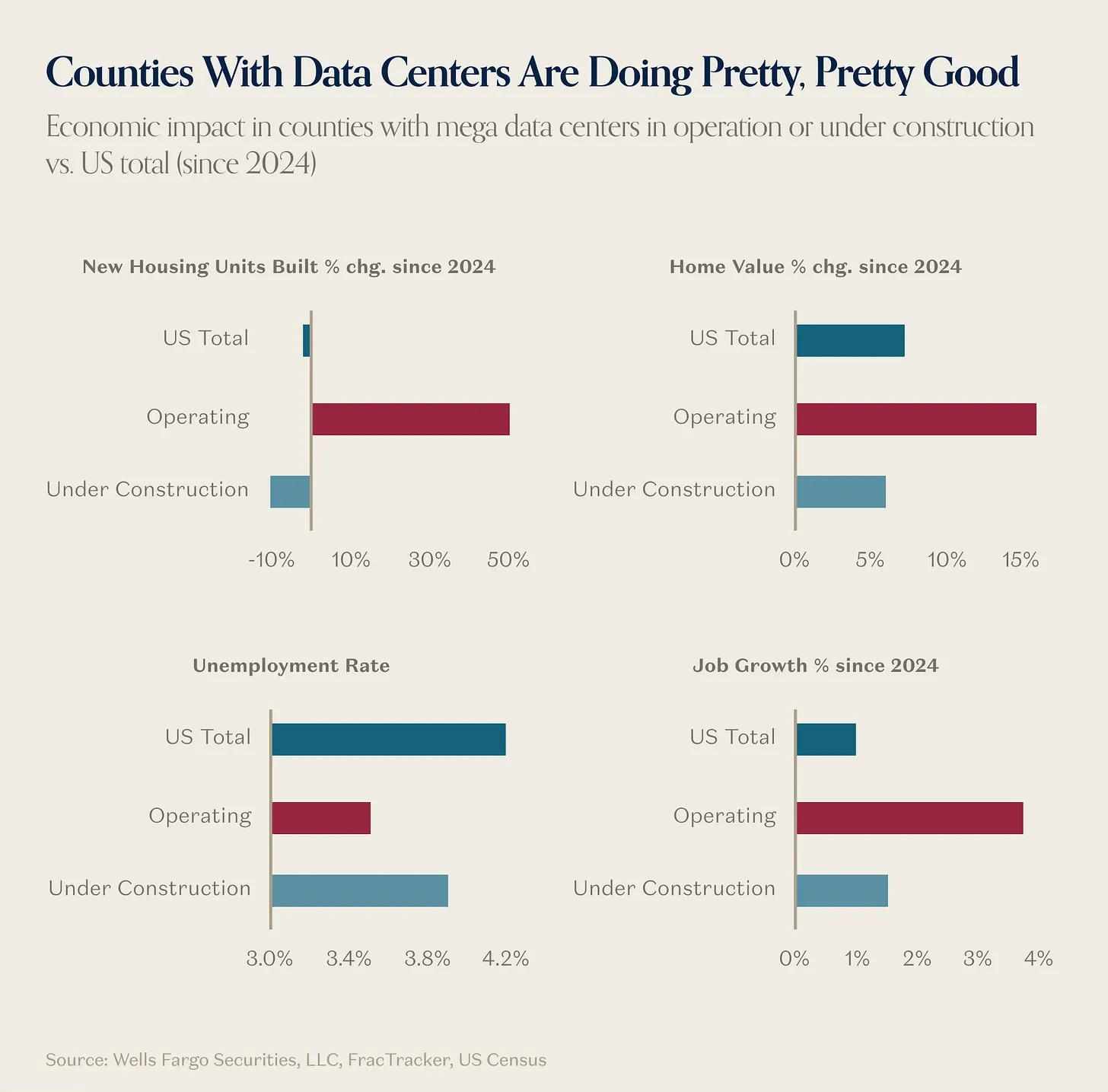
Since 2024, counties with operating data centers show more housing, higher home values, lower unemployment and faster job growth. Counties in the construction phase show the employment gain, a weaker housing picture, and less appreciation.
Wells Fargo.
Causation is not obvious. A lot of the operating capacity sits in Loudoun County, Virginia, one of the wealthiest counties in the country. A lot of the new builds sit in Texas, which ran a historic residential boom before 2024, so the housing retreat is measured off a very high base.
The employment effect is harder to argue with. Beyond the raw headcount, these sites pay better than the employers they are competing against for the same workers.
Data centers pay premium wages.
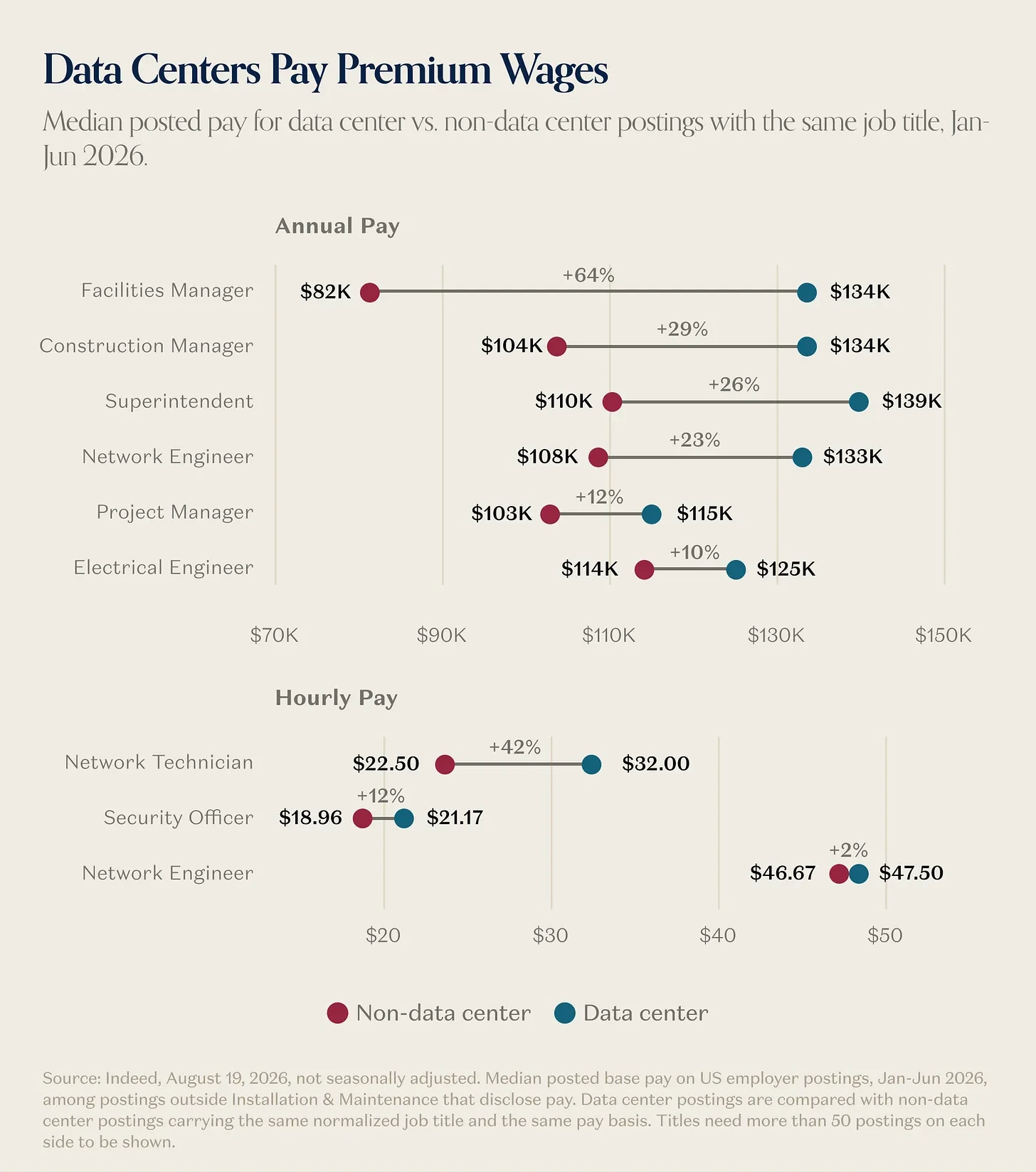
Indeed puts the data center wage premium as high as 64 percent for a facilities manager and around 10 percent for an electrical engineer. The premium is real, it is large, and it applies to a modest headcount relative to the capital deployed.
Indeed.
A heavy industrial construction contractor put it more plainly in a recent Dallas Fed report.
We have been paying what I believe to be a very competitive wage for skilled concrete workers, 28 to 32 dollars per hour. The data centers are offering 45 dollars per hour and a 150 dollar per diem for concrete workers.
That is roughly a 50 percent premium for concrete work. For the person taking it, that is not a data point. That is a different life.
Hard hat jobs are getting the biggest raises.
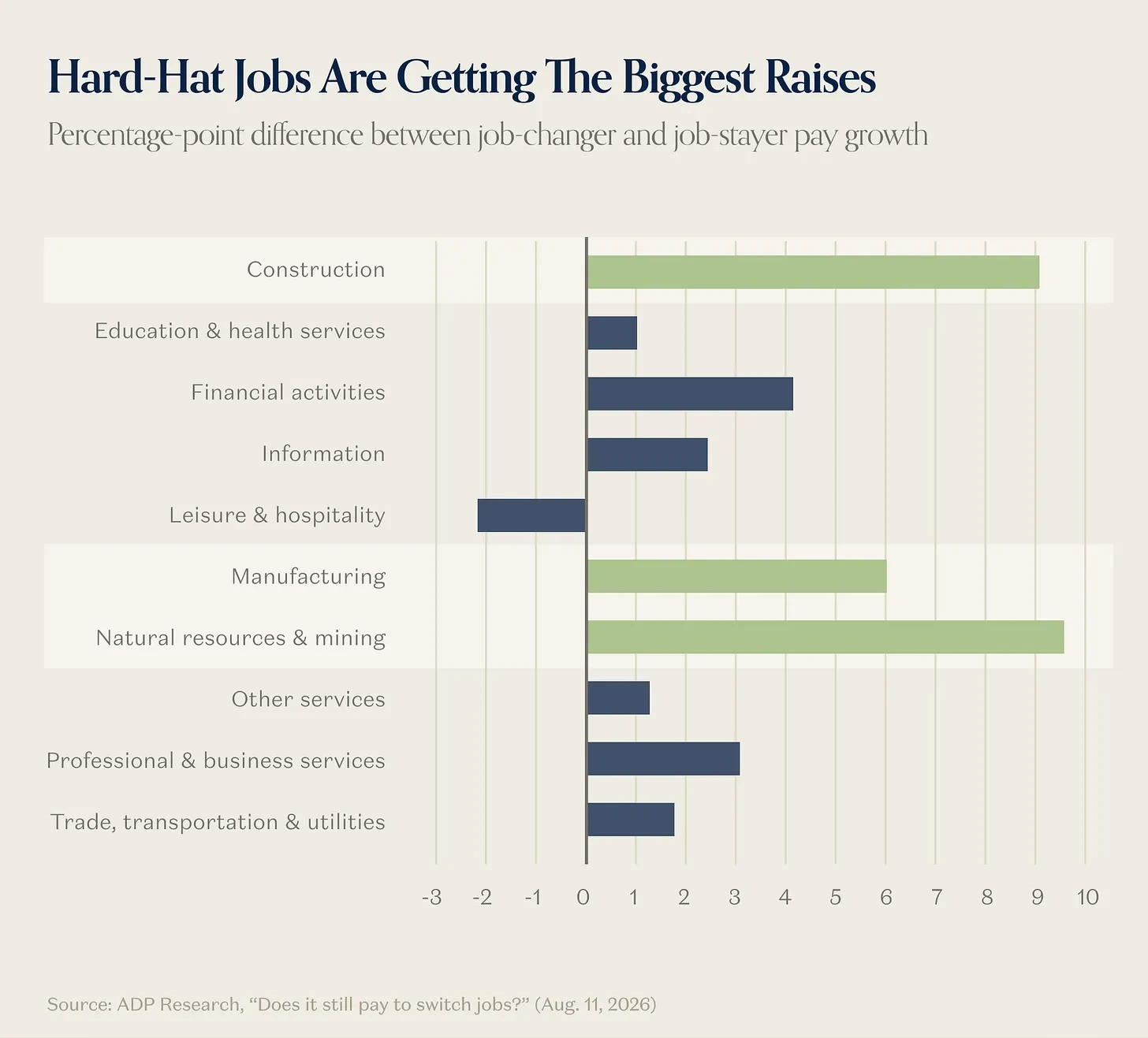
ADP puts the job switcher pay premium in construction, manufacturing and natural resources at 6 to 9.5 percentage points above job stayers, the widest spread of any sector. Switching pay is where you see demand before you see it anywhere else.
ADP.
Sit with that, because it inverts the story everyone has told since 2023. The technology that was supposed to compress white collar work first is, in measurable dollars, currently bidding up the price of skilled physical labor. Saying no to a data center now means saying no to the largest wage increase blue collar workers in that county are likely to see this decade.
For a small or medium sized business the consequence is boring and immediate. If you compete for tradespeople, your labor cost went up and it is not coming back down while the build runs. If you sell to contractors, your customers just got busier and better funded. If you do neither, your electricity rate is still in the conversation, because these facilities buy power in quantities that reshape a regional grid.
It is not your imagination, ridesharing really is more expensive.
If an Uber feels pricier than it used to, that is because it is. Gridwise Analytics has both the average and median Uber fare up about 20 percent since the start of 2024, and still climbing.
Ridesharing really does cost more.
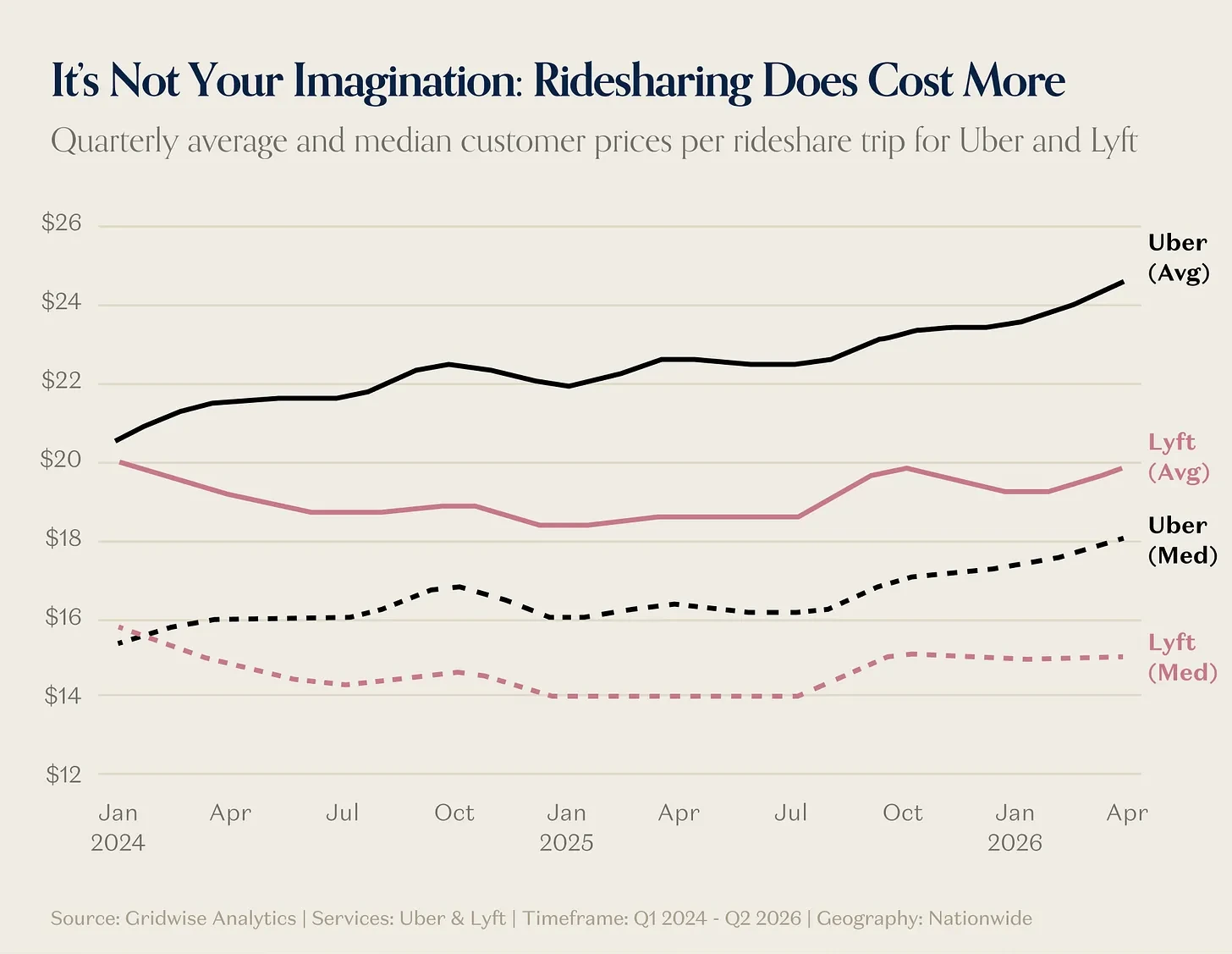
Uber is carrying the increase. Median and average Lyft rides are slightly cheaper than they were in early 2024 and run roughly 24 percent under Uber overall, though Lyft prices have started rising lately too.
Gridwise Analytics.
Platform fees are on the rise.
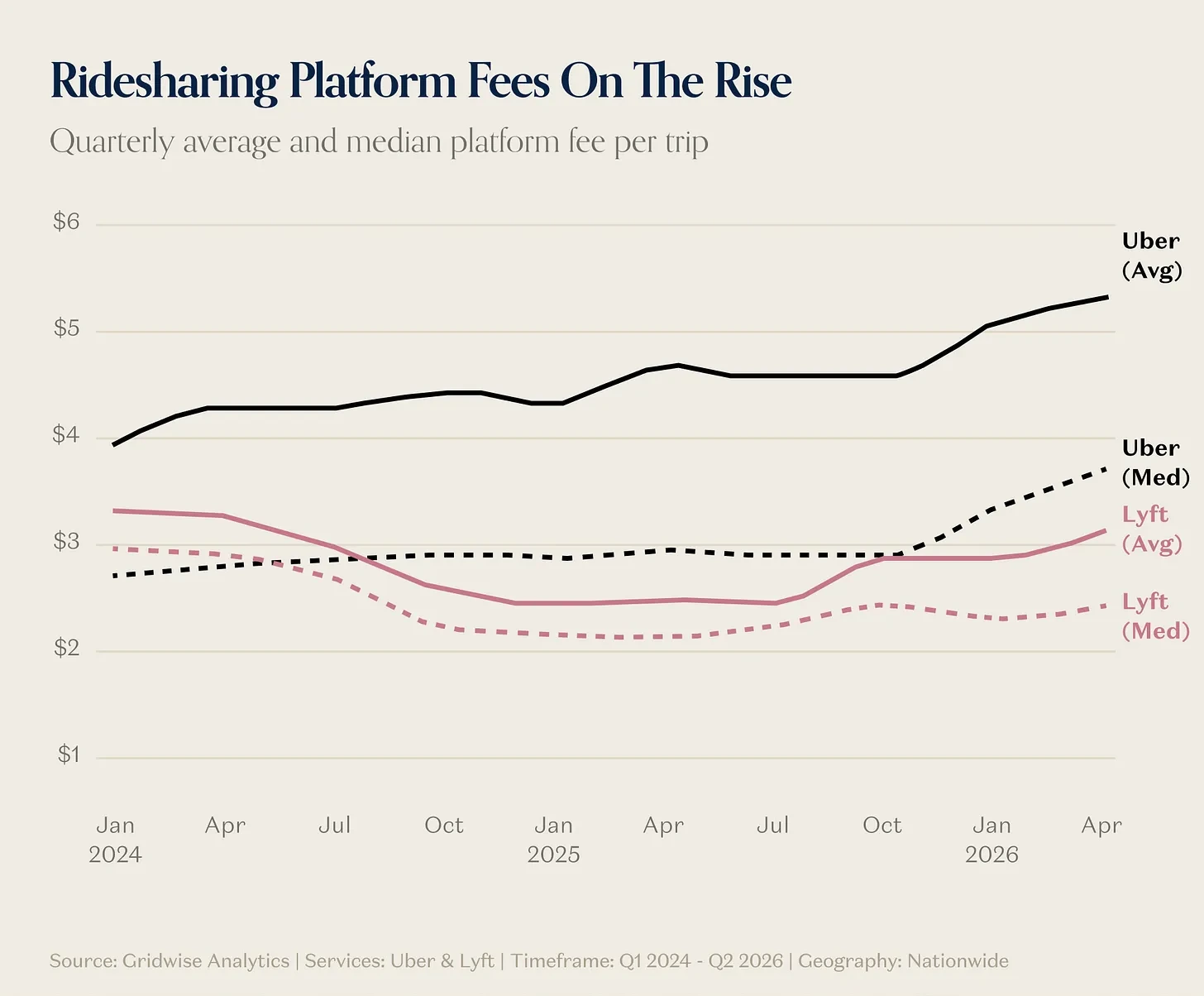
Uber's platform fee has climbed for more than a year, with a visible step up in the median in October. Lyft's fee only began rising recently, after a long decline.
Gridwise Analytics.
Good for Uber. Good for Lyft. Also, to be fair, good for the drivers.
Driver pay passed its previous all time high.
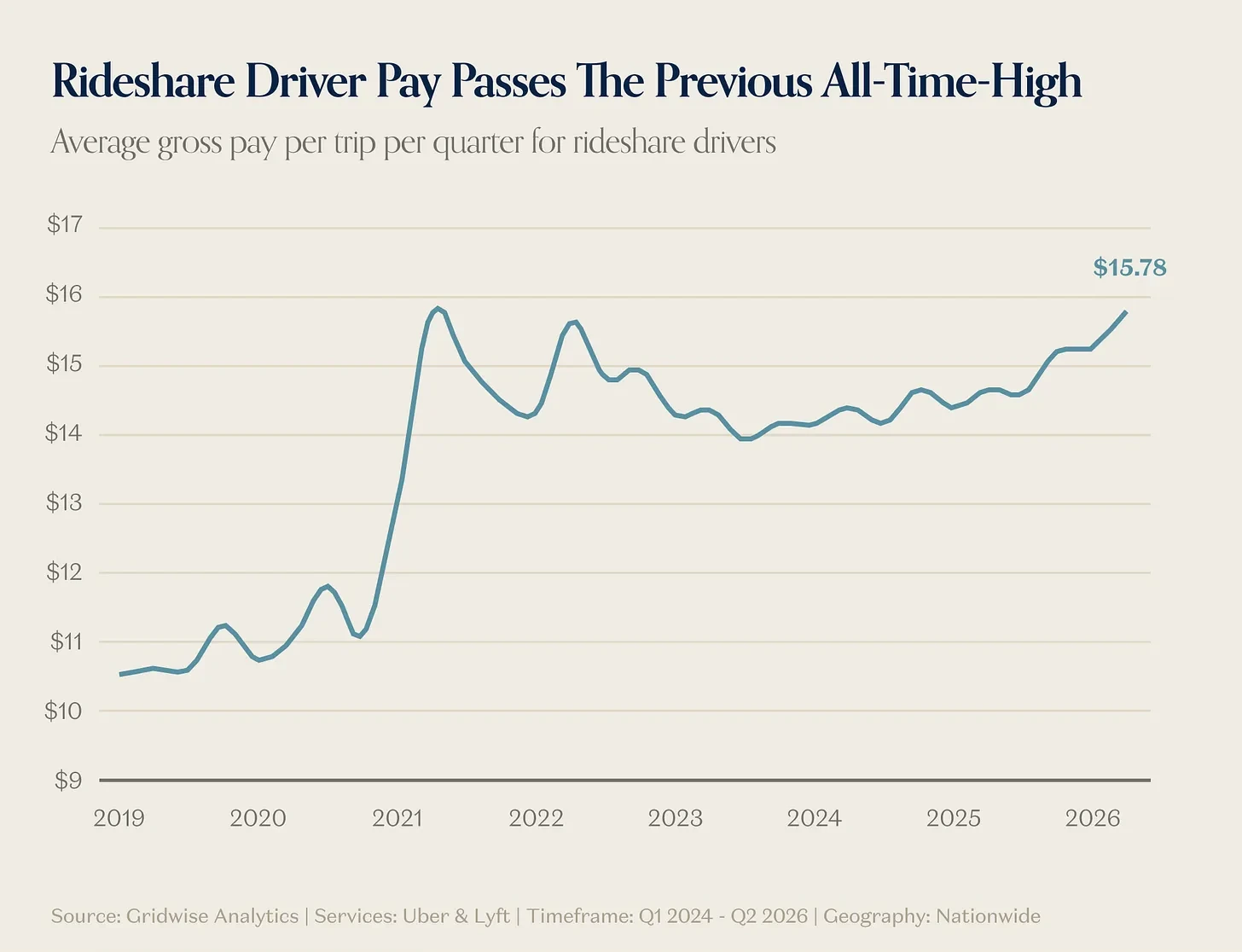
Average gross driver pay per trip has risen since 2024 and recently set a record. Both sides of the market are getting more per trip, which means the rider is funding both.
Gridwise Analytics.
The lazy read is that platforms are squeezing everyone. The data does not support it. The useful read is about what happens to a market once the intermediary owns the demand. Pricing power never arrives with an announcement. It shows up as a fee line that widens a few points a year in a market where nobody has anywhere else to go.
Every intermediary looks like a partner until it stops needing you more than you need it.
There is a version of this coming for AI software. Assistants and agent platforms are priced to acquire today, the way rides were priced to acquire in 2015. The companies that are fine in 2030 will be the ones holding the parts an intermediary cannot repossess: their data, their own definition of what good output looks like, and the customer relationship.
What an owner should actually do with this.
Charts are entertainment until they change a decision. Four decisions these ones should touch.
- Price your labor exposure now. If skilled trades sit anywhere in your cost base, model a second year of above trend wage growth rather than a reversion. Reversion is the optimistic case and it is not the case the capital flows support.
- Treat energy as a line item with volatility. Regional power demand is being reshaped by facilities that buy in gigawatts. Lock what you can lock, and know your rate structure well enough to spot a change when it arrives.
- Assume your AI vendor's price is introductory. Build on tools you can leave. Keep prompts, evaluation sets, and the data that makes the system work in systems you control, so a repricing is an annoyance instead of a migration project.
- Buy the boring capability, not the theme. The thematic trade is for portfolios. Inside a business, the return still comes from taking one manual job, measuring it, and replacing it with something that works on your stack. That is unglamorous and it compounds.
None of this requires a view on whether the build out is a bubble. It requires only the observation that a very large amount of money has already been committed, that commitments of this size move wages and prices before they move headlines, and that the businesses which prepare for second order effects tend to be the ones still standing when the first order story changes.
Nobody announces a cost curve when it bends. It arrives as a quote from an electrician that is eleven percent higher than the one you got last spring, and as a utility letter you almost throw away.
Common questions
Do data center construction jobs actually pay more?
Indeed's posting data shows facilities manager roles tied to data centers advertising about 64 percent above the comparable national posting, and the Dallas Fed's contacts have quoted concrete crews near 45 dollars an hour in build out regions. The premium sits with the skilled trades that pour foundations, pull conduit, and install cooling, and it is largest in counties where a single campus is big relative to everything else being built there.
Where is AI capex showing up first in the labor market?
It is showing up in construction and facilities pay. The measurable effect so far is higher wages for the trades building and running the campuses, concentrated in a handful of counties, while the white collar displacement story that dominates the commentary has not yet moved the aggregate employment data.
Which counties and states are most exposed to the data center build out?
Data center work now accounts for roughly 60 percent of non-residential construction in New Mexico and Wyoming, and similarly outsized shares in a short list of other states. Because the campuses cluster in a few counties, statewide and national averages understate what a local contractor or employer is competing against for labor.
How much money is flowing into ETFs this year?
Citadel's work puts ETF inflows on pace for roughly 600 billion dollars more than last year, which would be a record. Thematic products are taking a growing share of that money, and the theme absorbing most of it is the physical AI build out: power, land, steel, and the companies that supply them.
Why are rideshare prices rising while driver pay also hits records?
Gridwise data shows fares per trip and driver earnings both climbing, which is possible because the platform's cut has widened between the two. Riders pay more, drivers earn more in nominal terms, and the intermediary captures a larger slice of the gap as it consolidates share of the market.
What should a small or medium sized business do with this data?
Treat it as a hiring and pricing signal, not a market call. Employers competing for electricians, mechanical trades, or facilities staff inside a build out county should assume their labor costs have already reset upward and budget accordingly. Businesses selling through a dominant intermediary should expect its take rate to widen with its share, and should be building direct customer relationships now rather than after the terms change.